
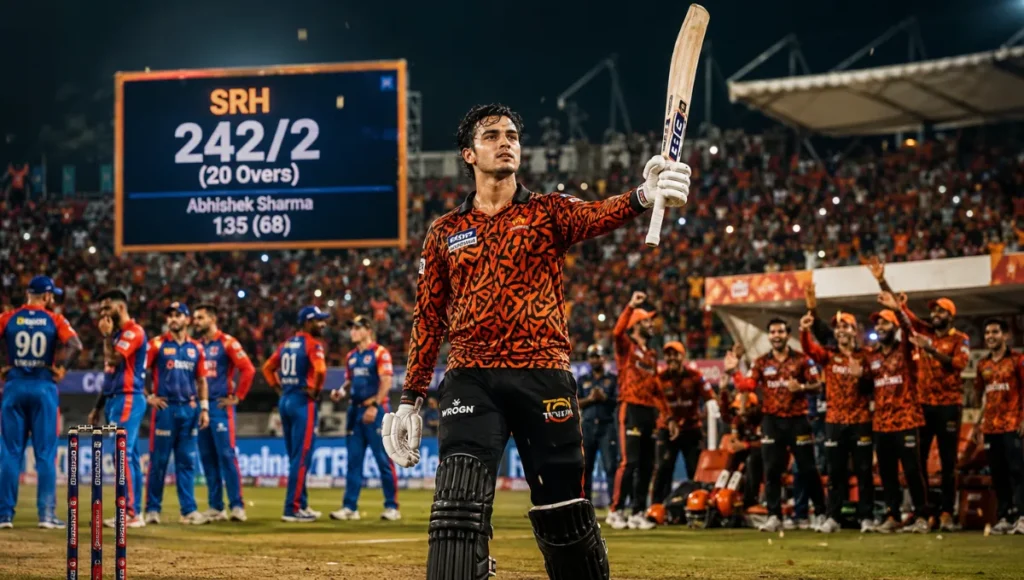

Delhi Capitals won the toss and chose to bowl first. On paper, that looked like the smart move at Rajiv Gandhi International Stadium. By the end of the powerplay, it looked like the costliest decision of their season.
Sunrisers Hyderabad posted 242 for 2 in 20 overs, built almost entirely around Abhishek Sharma’s unbeaten 135 off 68 balls. Delhi Capitals responded with 195 for 9, and lost by 47 runs. That is the result. But a scorecard alone cannot explain why Delhi never looked capable of chasing 243, or how one batter turned a good SRH total into an imposing one.
Here is the real problem with most SRH vs DC scorecard pages: they present the numbers and stop. They do not explain why Delhi’s bowling changes backfired, why Abhishek Sharma’s knock was tactically different from a typical big IPL hundred, or what actually decided the match inside the first six overs of each innings. This breakdown does.
Match Summary: SRH vs DC, 31st Match, IPL 2026
| Match detail | Information |
|---|---|
| Match | Sunrisers Hyderabad vs Delhi Capitals, 31st Match, IPL 2026 |
| Date | April 21, 2026 |
| Venue | Rajiv Gandhi International Stadium, Hyderabad |
| Toss | Delhi Capitals won the toss and chose to field |
| SRH score | 242/2 in 20 overs |
| DC score | 195/9 in 20 overs |
| Result | Sunrisers Hyderabad won by 47 runs |
| Player of the Match | Abhishek Sharma (135* off 68) |
Quick answer: Sunrisers Hyderabad beat Delhi Capitals by 47 runs in IPL 2026, powered by Abhishek Sharma’s unbeaten 135 off 68 balls. Delhi Capitals were restricted to 195 for 9 despite half-centuries from KL Rahul’s partner Nitish Rana (57) and a late fighting knock from Sameer Rizvi (41).
Full Scorecard at a Glance
Sunrisers Hyderabad innings: 242/2 in 20 overs
| Batter | Runs | Balls | 4s | 6s | Strike rate |
|---|---|---|---|---|---|
| Abhishek Sharma* | 135 | 68 | 10 | 10 | 198.53 |
| Heinrich Klaasen* | 37 | 13 | — | — | 284.61 |
| DC bowler | Overs | Runs | Wickets | Economy |
|---|---|---|---|---|
| Axar Patel | 2 | 23 | 1 | 11.50 |
| T Natarajan | 4 | 40 | 0 | 10.00 |
Delhi Capitals innings: 195/9 in 20 overs
| Batter | Runs | Balls | Dismissal |
|---|---|---|---|
| P Nissanka | 8 | 6 | Caught |
| KL Rahul | 37 | 23 | Caught |
| Nitish Rana | 57 | 30 | Caught |
| Sameer Rizvi | 41 | 28 | Caught |
| DA Miller | 0 | 1 | Bowled |
| T Stubbs | 27 | 16 | Caught |
| SRH bowler | Overs | Runs | Wickets | Economy |
|---|---|---|---|---|
| Eshan Malinga | 4 | 32 | 4 | 8.00 |
| Harsh Dubey | 2 | 12 | 3 | 6.00 |
| D Madushanka | 4 | 36 | 1 | 9.00 |
| Sakib Hussain | 4 | 29 | 1 | 7.25 |
Read Also:- India Vs Ireland T20 Series 2026: Full Scorecard, Analysis & Player Breakdown
The scorecard shows Abhishek Sharma faced 68 of SRH’s 120 deliveries.
What most people miss is what that actually means: he controlled 57 percent of Sunrisers’ entire innings on a night the team scored 242. This was not a supporting knock inside a big total. It was the total.
How Sunrisers Hyderabad Set Up the Win
1. Abhishek Sharma’s innings had two distinct gears
The common mistake when describing a 135 off 68 is calling it “aggressive from ball one.” That is not what happened. Abhishek admitted post-match that the pitch felt slow early, and SRH had to “re-plan” their powerplay approach. He built the first phase with control, then accelerated once he read the surface.
His attacking numbers back this up: he hit 10 fours and 10 sixes, with his most productive shot the off-drive worth 34 runs across three fours and three sixes. That is not random slogging. That is a batter identifying one specific scoring option and repeating it with precision through the innings.
What people think vs reality: Fans often assume a strike rate of 198 means a batter took huge risks throughout. Reality: Abhishek’s control percentage was 84%, meaning he middled the ball on the vast majority of deliveries. High strike rate with high control is a far more dangerous combination than raw risk-taking, because it removes the opposition’s best counter waiting for a mistake.
2. Delhi Capitals avoided a key match-up, and it cost them
Former player and commentator Aaron Finch directly criticised Delhi’s tactics, saying DC captain Axar Patel was “not willing to stand up” against the left-handed Abhishek Sharma. Axar himself bowled only 2 overs for the match, conceding 23 runs, and never set up a sustained spin match-up against SRH’s form batter.
This is the section most competitor scorecards skip entirely: the tactical decision, not just the outcome. When a captain avoids his best bowling weapon against the opposition’s most dangerous player, the game can be lost in the team meeting before it is lost in the middle overs. Delhi’s bowling never adjusted to isolate Abhishek Sharma, and by the time Klaasen arrived to finish the innings with 37 off 13, the total was already out of reach.
3. Klaasen’s cameo turned a big total into an overwhelming one
Heinrich Klaasen’s unbeaten 37 came off just 13 balls at a strike rate of 284.61.
This is the counterintuitive part of the innings: SRH did not need Klaasen to bat long. They needed him to bat fast, immediately, with zero settling-in period. He delivered exactly that role, adding 66 crucial runs in the last two overs alongside Abhishek without ever needing to build an innings of his own.
Practical lesson for analysing finishers: do not judge a finisher’s value by runs scored. Judge it by strike rate multiplied by the number of balls remaining when they arrive. Klaasen faced only 13 deliveries and still swung the match total by nearly 40 runs a phase-specific impact that a scorecard number alone will never show.
How Delhi Capitals’ Chase Fell Apart
The top order never got separation
Delhi’s early dismissals of Nissanka (8) and Rahul (37) meant the total kept climbing before any partnership could threaten SRH’s total. Rahul and Rana did put on a fighting stand worth noting, but Rana’s departure at the fall of the second wicket (86 runs) triggered the innings’ real collapse: three wickets fell for zero runs in the space of a handful of balls, as Miller, and then the middle order, folded immediately after Rana’s dismissal.
Common mistake in reading this chase: assuming Delhi lost because they could not score fast enough. The truth is more specific. Delhi lost because three wickets fell for 0 runs at a critical stage (86 to 86), removing any platform for the acceleration phase that was still needed against a target of 243.
Read Also:- India National Cricket Team Schedule: Full 2026 Calendar & Season Recap
Eshan Malinga and Harsh Dubey combined for the difference
Malinga’s 4 for 32 and Dubey’s 3 for 12 gave SRH combined figures of 8-0-61-5, if you isolate the two bowlers who did the most damage in the second half of the chase. Malinga specifically exploited the older ball’s condition, using reverse swing that he credited to working with Lasith Malinga in Sri Lanka before the season. Dubey, held back deliberately by captain Ishan Kishan to bowl only when the situation demanded control, took three wickets in his final over alone removing Axar Patel, Sameer Rizvi and Lungi Ngidi inside four balls.
This is a decision worth highlighting for readers who want more than a scorecard: Ishan Kishan revealed he specifically delayed introducing Dubey so that his best spin over would arrive exactly when Delhi’s best two batters were gone and panic had set in. That is a captaincy decision, not a lucky bowling change.
Player Performance Breakdown
| Player | Team | Key numbers | Match impact |
|---|---|---|---|
| Abhishek Sharma | SRH | 135* (68), 10×4, 10×6 | Player of the Match; produced 56% of SRH’s total individually |
| Heinrich Klaasen | SRH | 37* (13) | Turned a strong total into a near-unchaseable one in two overs |
| Eshan Malinga | SRH | 4/32 in 4 overs | Broke Delhi’s middle order using reverse swing |
| Harsh Dubey | SRH | 3/12 in 2 overs | Took 3 wickets in the final over, sealing the result |
| Nitish Rana | DC | 57 (30) | Delhi’s only genuine attacking response, but isolated |
| Sameer Rizvi | DC | 41 (28) | Fought late, but too far behind the required rate |
Abhishek Sharma: the standout performer
This was Abhishek Sharma’s second IPL century and his seventh Player of the Match award in 81 games for SRH the most for any Indian player in the franchise’s history, surpassing Bhuvneshwar Kumar’s six awards across 145 matches. That statistic alone should end any debate about whether this was a one-off innings. It is now a pattern.
Bold opinion: Abhishek Sharma has quietly become more valuable to SRH’s top order than any overseas power-hitter on their roster, because he can control tempo in the first six overs and still finish an innings at a strike rate near 200. Most explosive top-order batters can do one or the other. He is doing both in the same innings, repeatedly.
Eshan Malinga: the bowler nobody is talking about enough
Malinga’s figures of 4/32 matched the best-ever bowling figures by an overseas bowler for SRH, alongside Mohammad Nabi’s 4/11 and Darren Sammy’s 4/22 from previous seasons. Commentary after the match noted that SRH’s bowling attack, once considered their weak link this season, is now the only unit in the league successfully defending totals in every match they’ve played this way. That is a bigger story than a single scorecard line.
Nitish Rana: a lone fighter in a losing cause
Rana’s 57 off 30 balls was Delhi’s best individual contribution, but it happened in isolation. He built a stand of 65 with Rahul, but once both fell in the same passage of play, Delhi had no second partnership to rely on.
This is the same story as SRH’s own strength: partnerships decide totals, not individual fifties. Rana’s innings simply arrived on the wrong side of that pattern.
Key Moments and Match Timeline
| Phase | Key moment | Impact |
|---|---|---|
| SRH innings, overs 1–6 | Abhishek re-plans his approach on a slower pitch | Sets up a controlled foundation instead of an early collapse |
| SRH innings, overs 15–20 | Klaasen joins and scores 37 off 13 | Total jumps from a defendable score to a near-impossible target |
| DC innings, overs 1–6 | Nissanka and Rahul fall inside the powerplay’s first phase | Delhi immediately behind the required rate |
| DC innings, mid-innings | Rana and Rahul’s 65-run stand builds hope | Best chance for Delhi to stay in the chase |
| DC innings, overs 10–12 | Three wickets fall for 0 runs after Rana’s dismissal | Chase effectively ends here |
| DC innings, over 19 | Harsh Dubey takes 3 wickets in one over | Confirms the margin of defeat |
The single most useful visual for this match is not a generic run-rate graph. It is a wickets-clustering chart showing Delhi’s three wickets falling for zero runs in the middle overs the exact passage where a 243-chase either stays alive or ends. No competitor scorecard currently isolates that moment as the actual turning point.
What This Result Means on the Points Table
| Team | M | W | L | Pts | NRR |
|---|---|---|---|---|---|
| RCB | 14 | 9 | 5 | 18 | 0.783 |
| GT | 14 | 9 | 5 | 18 | 0.695 |
| SRH | 14 | 9 | 5 | 18 | 0.524 |
| RR | 14 | 8 | 6 | 16 | 0.189 |
| PBKS | 14 | 7 | 6 | 15 | 0.309 |
| DC | 14 | 7 | 7 | 14 | −0.651 |
Read Also:- T20 World Cup Standings: Full Points Table, Qualification Race & Final Result
This win moved Sunrisers Hyderabad to third on the table and marked their third consecutive victory, a sharp turnaround after a poor start to the season. Delhi Capitals remained at fifth, and the manner of the defeat being dismissed for 195 while chasing 243 pushed their net run rate further into negative territory, a detail that could matter significantly in a tightly packed mid-table race.
Practical takeaway for readers tracking the playoff race: a comfortable defeat like this hurts a team twice once in the points column, and once in the NRR column, which becomes the tiebreaker exactly when it matters most in the final weeks of the league stage.
Frequently Asked Questions
Q1. Who won the Sunrisers Hyderabad vs Delhi Capitals match in IPL 2026?
Q2. Who was Player of the Match in SRH vs DC IPL 2026?
Q3. What was the full scorecard of SRH vs DC, 31st Match, IPL 2026?
Q4. Who took the most wickets for Sunrisers Hyderabad against Delhi Capitals?
Q5. Where was the SRH vs DC IPL 2026 match played?
Final Analysis
This was not a case of one big innings overshadowing a competitive match. Abhishek Sharma’s 135 decided the game inside SRH’s own innings, and Delhi Capitals never recovered from losing three wickets for zero runs in the middle overs. Delhi’s tactical decision to avoid a direct match-up between Axar Patel and Abhishek Sharma will be scrutinised long after this scorecard is forgotten, because it is the kind of decision that separates a defendable total from an unreachable one.
For Sunrisers Hyderabad, the bigger story is consistency. This was their third straight win, built on a top order that can control tempo and a bowling attack, led by Malinga and Dubey, that has quietly become one of the most disciplined death-overs units in the competition. For Delhi Capitals, the lesson is not about a single fifty from Rana. It is about building two partnerships in a run chase, not one.