
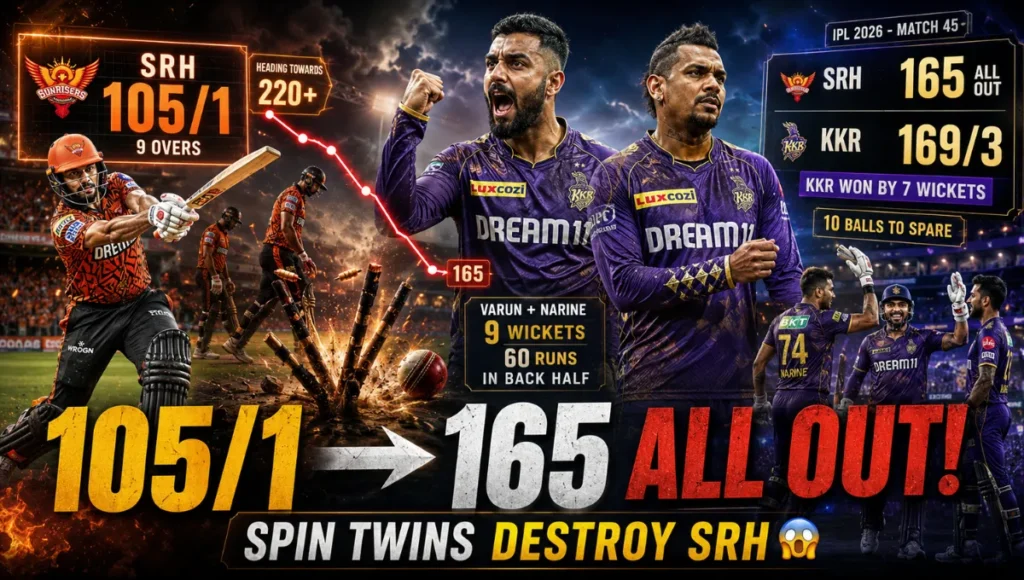

Sunrisers Hyderabad were 105 for 1 after nine overs. On that trajectory, they were headed toward 220, maybe more.
They finished on 165 all out.
Kolkata Knight Riders’ spin twins, Varun Chakaravarthy and Sunil Narine, combined to take nine SRH wickets for just 60 runs in the back half of the innings and Kolkata chased down the target with seven wickets and 10 balls to spare, ending SRH’s five-match winning streak in the process.
This Sunrisers Hyderabad vs Kolkata Knight Riders match scorecard covers the full 45th Match of IPL 2026 at Hyderabad. The final numbers, 165 and 169/3, don’t come close to telling the real story of how this match was actually decided.
Match in 30 Seconds
| Detail | Match information |
|---|---|
| Match | 45th Match, Indian Premier League 2026 |
| Venue | Rajiv Gandhi International Stadium, Hyderabad |
| Date | 3 May 2026 |
| Toss | Sunrisers Hyderabad won the toss and elected to bat |
| Sunrisers Hyderabad score | 165 all out in 19 overs |
| Kolkata Knight Riders score | 169/3 in 18.2 overs |
| Result | Kolkata Knight Riders won by 7 wickets |
| Player of the Match | Varun Chakaravarthy — 3/36 |
The one-line story: SRH built a strong platform through Travis Head and Ishan Kishan, then lost nine wickets for 60 runs as KKR’s spin twins took over, before Ajinkya Rahane and Angkrish Raghuvanshi’s 84-run stand carried Kolkata home comfortably.
What people think is that a team sitting at 105/1 after nine overs has already done the hard work and is coasting toward a big total.
The reality here was the opposite: SRH’s innings effectively ended at the nine-over mark, even though the scorecard kept ticking for another ten overs.
Sunrisers Hyderabad vs Kolkata Knight Riders Match Scorecard
Sunrisers Hyderabad innings: 165 all out in 19 overs
| Batter | Runs | Balls | 4s | 6s | Strike rate | Dismissal |
|---|---|---|---|---|---|---|
| Abhishek Sharma | 15 | 10 | 1 | 1 | 150.00 | c Green b Tyagi |
| Travis Head | 61 | 28 | 9 | 3 | 217.86 | c Green b Chakravarthy |
| Ishan Kishan (wk) | 42 | 29 | 4 | 2 | 144.83 | c Roy b Narine |
| Heinrich Klaasen | 11 | 8 | 1 | 1 | 137.50 | c Powell b Green |
| Ravichandran Smaran | 4 | 4 | 1 | 0 | 100.00 | c Rahane b Chakravarthy |
| Aniket Verma | 6 | 8 | 1 | 0 | 75.00 | c Rahane b Chakravarthy |
| Salil Arora | 2 | 6 | 0 | 0 | 33.33 | b Narine |
| Pat Cummins (c) | 10 | 8 | 0 | 1 | 125.00 | c & b Roy |
| Shivang Kumar | 1 | 2 | 0 | 0 | 50.00 | c Raghuvanshi b Arora |
| Harshal Patel | 6 | 5 | 1 | 0 | 120.00 | c Arora b Tyagi |
| Eshan Malinga | 2 | 6 | 0 | 0 | 33.33 | not out |
| Extras | 5 | — | — | — | — | 1 b, 4 w |
| Total | 165 | 19 overs |
Fall of wickets: 44/1 (Abhishek Sharma, 3.4), 105/2 (Travis Head, 8.6), 117/3 (Heinrich Klaasen, 10.4), 122/4 (Ravichandran Smaran, 11.3), 135/5 (Aniket Verma, 13.4), 139/6 (Salil Arora, 15.1), 148/7 (Ishan Kishan, 15.6), 156/8 (Pat Cummins, 16.6), 156/9 (Shivang Kumar, 17.1), 165/10 (Harshal Patel, 18.6).
KKR bowling figures
| Bowler | Overs | Runs | Wickets | Economy |
|---|---|---|---|---|
| Sunil Narine | 4 | 31 | 2 | 7.75 |
| Salil Arora | 3 | 25 | 1 | 8.33 |
| Kartik Tyagi | 4 | 30 | 2 | 7.50 |
| Cameron Green | 3 | 34 | 1 | 11.33 |
| Varun Chakaravarthy | 4 | 36 | 3 | 9.00 |
| Anukul Roy | 1 | 8 | 1 | 8.00 |
Kolkata Knight Riders innings: 169/3 in 18.2 overs
| Batter | Runs | Balls | 4s | 6s | Strike rate | Dismissal |
|---|---|---|---|---|---|---|
| Ajinkya Rahane (c) | 43 | 36 | 4 | 1 | 119.44 | c Smaran b Sakib Hussain |
| Finn Allen | 29 | 13 | 3 | 2 | 223.08 | c Klaasen b Cummins |
| Angkrish Raghuvanshi (wk) | 59 | 47 | 5 | 2 | 125.53 | c Malinga b Kumar |
| Rinku Singh | 22 | 11 | 2 | 1 | 200.00 | not out |
| Cameron Green | 3 | 3 | 0 | 0 | 100.00 | not out |
| Extras | 13 | — | — | — | — | 1 lb, 12 w |
| Total | 169/3 | 18.2 overs |
Fall of wickets: 49/1 (Finn Allen, 3.6), 133/2 (Ajinkya Rahane, 14.6), 151/3 (Angkrish Raghuvanshi, 16.4).
SRH bowling figures
| Bowler | Overs | Runs | Wickets | Economy |
|---|---|---|---|---|
| Abhishek Sharma | 2 | 14 | 0 | 7.00 |
| Pat Cummins | 4 | 47 | 1 | 11.75 |
| Eshan Malinga | 3.2 | 42 | 0 | 12.60 |
| Shivang Kumar | 4 | 31 | 1 | 7.75 |
| Harshal Patel | 2 | 17 | 0 | 8.50 |
| Sakib Hussain | 3 | 17 | 1 | 5.66 |
Highlights and Key Moments
1. Head and Kishan built a platform that promised much more than 165
Travis Head’s 61 off 28 and Ishan Kishan’s 42 off 29 gave SRH exactly the start they wanted, reaching 105/1 after nine overs the kind of platform that, on this ground, usually projects toward 220 or more.
What most people miss: a fast start with only one wicket down is not automatically a guarantee of a big total. It’s an opportunity that still needs to be converted, over by over, by whoever comes next. SRH’s next ten overs would prove exactly why that conversion is never automatic.
2. The spin twins triggered a nine-wickets-for-60 collapse
From 105/1, SRH lost their next nine wickets for just 60 runs. Varun Chakaravarthy took 3/36, dismissing Head, Smaran, and Verma. Sunil Narine took 2/31, removing Kishan and Arora. Together, their combined figures of 5/67 across eight overs dismantled SRH’s middle and lower order.
Counterintuitive point: Chakaravarthy’s own explanation reveals why this worked so late in the innings rather than earlier: “Initially when IPL starts, the first four matches will be flat wickets. It’s very tough for spinners to come into the game… As the tournament goes on, spinners come into the game.” This wasn’t a fluke spell it was a bowler explicitly describing a seasonal pattern that finally paid off in his team’s favour.
3. Allen’s cameo and the 84-run stand that won the chase
Finn Allen’s quickfire 29 off 13 gave KKR early momentum before he fell in the fourth over. Ajinkya Rahane and Angkrish Raghuvanshi then built an 84-run stand for the second wicket, with Raghuvanshi batting the more fluently of the two to reach a mature fifty after three low scores in previous matches.
This is where things go wrong for a chasing side trying to defend a below-par total: once KKR’s set batters had absorbed the powerplay pressure through Allen’s cameo, the required rate never became a genuine threat. Rahane and Raghuvanshi were dismissed within 11 deliveries of each other late in the innings, but by then the match state was already fully in KKR’s control.
4. Rinku Singh finished it in style
With KKR closing in on the target, Rinku Singh finished the match with an unbeaten 22 off 11 balls, striking the winning boundary off Eshan Malinga in the 18.2nd over.
Bold opinion: Rinku’s cameo gets remembered as a routine finish, but a specialist finisher closing out a chase in 11 balls without any visible pressure is itself a skill many teams lack. KKR’s ability to bring in a player purpose-built for exactly this situation, rather than relying on whoever happened to be at the crease, is a structural advantage that shows up repeatedly across their recent matches.
Player Performance Breakdown
Varun Chakaravarthy 3/36: Player of the Match and a season turnaround
Chakaravarthy’s figures of 3/36 came after what his own captain, Ajinkya Rahane, described as a difficult start to the season: “He was struggling before the tournament and even going into the tournament first couple of games. The way he came back was amazing.”
Original observation: Chakaravarthy’s award is a genuinely instructive case study in patience with struggling specialists. Rather than being dropped after a poor start, he was backed through his early-season struggles, and this match with a Player-of-the-Match performance that also moved him to 8th on the all-time list for POTM awards by specialist wrist-spinners is the direct payoff of that patience.
Sunil Narine: the other half of KKR’s spin threat
Narine’s 2/31 from four overs worked in tandem with Chakaravarthy’s spell rather than in isolation. He removed Ishan Kishan, SRH’s most fluent remaining batter after Head’s dismissal, and later took the wicket of Salil Arora to keep the collapse moving.
Practical lesson for captains managing two frontline spinners: the value of a spin-bowling pair isn’t just their combined wicket count it’s that batters facing constant variation between two genuinely different styles (Chakaravarthy’s mystery spin and Narine’s flatter, quicker darts) rarely get the chance to settle into a rhythm against either one specifically.
Ajinkya Rahane and Angkrish Raghuvanshi: the partnership that won the match
Rahane’s 43 off 36 and Raghuvanshi’s 59 off 47 formed an 84-run stand that effectively decided the chase.
Raghuvanshi credited the simplicity of his communication with his captain: “When I bat with Ajinkya bhaiya, the communication is really good. He just tells me to watch the ball and react. Calms me down.”
What people think vs reality: fans might assume a match-winning partnership needs two batters striking at similarly explosive rates. Here, Rahane’s more measured 119.44 strike rate paired with Raghuvanshi’s slightly higher 125.53 to form a genuinely stabilising partnership proof that a successful stand doesn’t require two batters trying to out-hit each other, just two batters rotating strike and building without unnecessary risk.
Travis Head: SRH’s best innings in a losing cause
Head’s 61 off 28 balls, striking at 217.86 with nine fours and three sixes, was comfortably SRH’s most destructive individual batting performance of the match. His dismissal, caught by Cameron Green off Chakaravarthy, was the moment SRH’s momentum genuinely began to shift.
Common mistake in analysis: crediting only the total runs scored while ignoring when a key wicket fell relative to the game’s overall shape. Head’s dismissal at 105/2, right at the transition point between SRH’s fast start and their eventual collapse, makes his innings the platform for the collapse as much as it was a genuine positive for SRH.
Analysis: Why SRH’s Platform Didn’t Become a Total
105/1 needed to become 190-plus, not 165
What people think: a score of 105/1 after nine overs, in a format where 200 is a realistic ceiling, all but guarantees a total in the 200s.
Reality: the batters who followed Head and Kishan managed just 60 runs combined while losing eight wickets across the remaining eleven overs. A platform is only valuable if the middle and lower order convert it and here, KKR’s spin twins made sure that conversion never happened.
Cummins’ own admission tells the real story
SRH captain Pat Cummins was direct in his post-match reflection: “Probably from where we were, we should have found a way to get higher, you know, up around 200 or past 180… I think 180, something like that [was par]. But again, from where we were, I think we should have got 180 plus.”
Bold opinion: a captain openly stating his team fell 15-35 runs short of their own realistic target is a far more honest and useful diagnostic than any external analysis. This wasn’t a case of KKR bowling unplayable deliveries throughout it was SRH’s batting failing to convert a strong platform into the total their own captain believed was achievable.
KKR’s bowling turnaround and season-long head-to-head advantage
Rahane credited KKR’s bowling coaches, Bravo and Southee, for a turnaround built on “a lot of talking, lot of planning, different oppositions, different grounds,” despite KKR having lost their first five matches of the season. This win extended KKR’s historic head-to-head dominance over SRH to 21 wins in 32 matches the joint second-most wins for any team against a single opponent in IPL history, behind only Mumbai Indians’ 25 wins over KKR. Notably, SRH have never completed a league double over KKR across 14 seasons.
Practical takeaway for team analysis: a team’s head-to-head history against a specific opponent can reflect genuine, repeatable tactical patterns rather than coincidence. KKR’s specific plan of using two contrasting spinners in the middle overs has clearly troubled SRH’s batting order across many matches, not just this one.
Records, Points Table Impact and Format Guardrail
Records set or extended in this match
| Record | Detail |
|---|---|
| KKR’s all-time wins vs SRH | 21 wins in 32 matches — joint second-most wins by any team against a single opponent in IPL history |
| SRH’s league-double record vs KKR | SRH have never completed a league double over KKR across 14 IPL seasons |
| Varun Chakaravarthy’s POTM tally | Moved to 8th on the all-time list of most Player of the Match awards by specialist wrist-spinners |
| Catch success rate, IPL 2026 (at this point) | KKR led all teams at 88.6%, ahead of Rajasthan Royals (87.2%) and RCB (85.7%) |
Format and fixture guardrail
| Fixture | Correct context |
|---|---|
| SRH vs KKR, 45th Match, IPL 2026 (this article) | The streak-ending match — this article’s core scorecard |
| KKR vs SRH, 6th Match, IPL 2026 | An earlier meeting between the same two teams in the same season; different result and context |
| KKR vs SRH, 2023 (Gujarat Titans archive) | A completely different season and squad composition |
| SRH vs KKR, 2020 (Punjab Kings archive) | An even older, unrelated season |
Do not present the 6th Match or either archive fixture’s figures as part of this 45th Match scorecard. Each belongs to a separate point in the two franchises’ history.