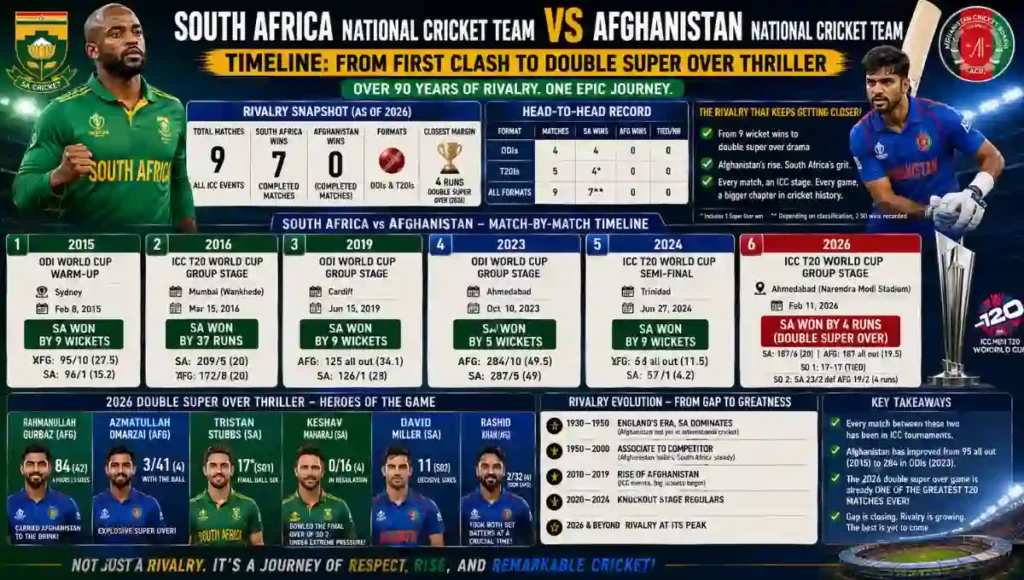

The south africa national cricket team vs afghanistan national cricket team timeline spans nine official international matches across ODIs and T20Is, played entirely in ICC tournament settings from 2015 to 2026. South Africa have won all completed matches 7 wins overall but the rivalry has grown dramatically closer, culminating in one of the greatest T20 games ever played: a double Super Over thriller at the ICC Men’s T20 World Cup 2026 in Ahmedabad, where South Africa won the second Super Over by just 4 runs.
Quick Rivalry Snapshot
| Category | Details |
| Total Matches | 9 |
| South Africa Wins | 7 |
| Afghanistan Wins | 0 (completed matches) |
| Format Breakdown | 4 ODIs, 5 T20Is |
| Closest Margin | 4 runs 2026 Double Super Over |
| First Match | 2015 ODI World Cup Warm-Up, Sydney |
| Most Recent Match | February 11, 2026 T20 World Cup, Ahmedabad |
| Most Impactful Performer | Rahmanullah Gurbaz 84 off 42 (2026) |
Why This Rivalry Matters More Than the Record Suggests
The south africa national cricket team vs afghanistan national cricket team timeline is not a story of dominance. It is a story of evolution. South Africa rejoined international cricket in 1991 after apartheid-era isolation and established themselves as one of the sport’s elite nations. Afghanistan, by contrast, formed their Cricket Board only in 1995 and were playing associate cricket in refugee communities barely two decades ago.
What separates this rivalry from most: these two sides have never met in a bilateral series. Every encounter has come on the ICC tournament stage, under maximum pressure, with tournament lives at stake. That context makes each result more significant than the scoreline alone.
By May 2025, Afghanistan had climbed to seventh in ICC Men’s ODI Rankings ahead of England and the West Indies with a rating of 91. South Africa, positioned just above them, understand this threat better than any other nation. The gap between these teams is not what it once was.
Complete South Africa vs Afghanistan Match-by-Match Timeline
The complete south africa national cricket team vs afghanistan national cricket team timeline across all formats tells a story that simple head-to-head numbers cannot.
2015 ICC ODI World Cup Warm-Up Sydney
Result: South Africa won by 9 wickets
Afghanistan arrived at the 2015 World Cup in Australia and New Zealand as first-time ICC World Cup participants. The Proteas dismissed them cheaply and chased down the target with more than ten overs to spare. The result was predictable. The significance was not. This was Afghanistan’s debut on cricket’s biggest stage a moment that set the baseline for everything that followed.
Snippet answer: South Africa won by 9 wickets in their first-ever meeting a warm-up match at the 2015 ODI World Cup in Sydney.
2016 ICC T20 World Cup Mumbai (Wankhede Stadium)
Result: South Africa won by 37 runs
South Africa posted 209/5 one of their highest T20I totals at the time. Hashim Amla and Faf du Plessis powered the innings. A young Rashid Khan, in his breakout ICC tournament, conceded runs but showed enough to signal what was coming. Afghanistan’s reply reached 172 a genuinely competitive total that most teams would find difficult to overhaul.
What most analysts miss about this game: losing by 37 runs while chasing 210 is not a collapse. It is a statement. Afghanistan were already scoring at rates that competitive T20 sides aspire to.
2019 ICC ODI World Cup Cardiff
Result: South Africa won by 9 wickets
Afghanistan posted 125 all out and were dismissed in 34.1 overs. South Africa chased in 28.4 overs. This looks like a demolition and on paper, it was. But Afghanistan’s 2019 World Cup was derailed by widely documented internal team management issues that impacted selection and batting order throughout the tournament. This result reflects dysfunction, not actual quality. The team that turned up in Cardiff was not the Afghanistan that had been competing globally.
2023 ICC ODI World Cup Ahmedabad
Result: South Africa won by 5 wickets
This match redefined the south africa national cricket team vs afghanistan national cricket team timeline in ODI cricket. Afghanistan posted 284 batting first compared to 125 in 2019, that is a 159-run improvement in four years at the same level. Rahmat Shah played a mature, structured innings. Rashid Khan contributed vital runs lower down the order.
South Africa chased 284 with limited overs to spare. A 5-wicket win against a 284-run total is not comfortable cricket. This was a significant match that confirmed Afghanistan’s ODI batting had genuinely developed.
2024 ICC T20 World Cup Semifinal Trinidad
Result: South Africa won by 9 wickets
Afghanistan reached their first-ever ICC World Cup semifinal an achievement of historic proportions for a nation that began playing ICC associate cricket less than 20 years earlier. South Africa were clinical. Afghanistan collapsed to 56 all out, their batting depth exposed under knockout-stage pressure that was categorically different from group matches. South Africa chased it with 10 overs remaining.
The counterintuitive reality: the 56 all out tells you less about Afghanistan than the fact that they even reached a semifinal. Their batting fragility under sustained pace bowling in seaming conditions is a real weakness but their bowling and lower-order character had already beaten Pakistan, Bangladesh, and New Zealand to get there.
2026 ICC T20 World Cup Ahmedabad (The Double Super Over)
Result: South Africa won the second Super Over by 4 runs
This match requires its own section. It is the defining chapter of this entire rivalry.
Head-to-Head Records Across All Formats
| Format | Matches | South Africa Wins | Afghanistan Wins | Ties/NR |
| ODIs | 4 | 4 | 0 | 0 |
| T20Is | 5 | 4* | 0 | 0 |
| Overall | 9 | 7** | 0 | 0 |
*The 2026 T20 WC match ended tied and was decided by Super Over
**Crex records 2 Afghanistan wins in certain head-to-head databases depending on how tied-then-Super-Over results are classified
South Africa have won every completed match. But the progression of those wins 9 wickets, 37 runs, 9 wickets, 5 wickets, then a double Super Over decided on the final ball tells a story no raw record can.
How Each Team Plays: Tactical Identity
Understanding the south africa national cricket team vs afghanistan national cricket team timeline requires understanding how differently these two sides approach the game.
South Africa’s Blueprint: Pace, Power, and Fielding Pressure
South Africa’s T20 and ODI identity is built on three non-negotiable pillars: a fast bowling attack that generates genuine bounce (Kagiso Rabada, Lungi Ngidi, Marco Jansen), top-order batting that transitions from accumulation to aggression seamlessly (Quinton de Kock, Ryan Rickelton), and fielding standards that convert half-chances into wickets.
Against Afghanistan specifically, South Africa have used powerplay pace to target early wickets before Afghanistan’s spin-friendly middle-order batters settle. This strategy worked in 2019 and 2024. It did not work in 2026, when Gurbaz and the opening partnership made 50 in four overs.
What people think vs reality: People believe South Africa always control games against Afghanistan. In 2026, South Africa needed two Super Overs and survived on a final-ball run-out to win. Control was not the word.
Afghanistan’s Weapon: Spin, Aggression, and Belief
Afghanistan’s bowling attack anchored by Rashid Khan and Noor Ahmad is one of the most dangerous spin units in world cricket. On subcontinental pitches, they generate turn, awkward angles, and dismissals that world-class batters struggle to read.
Their batting has transformed from fragile to unpredictable. Rahmanullah Gurbaz is now one of the most dangerous T20 openers in the world. Azmatullah Omarzai provides genuine hitting from the middle overs through the death. The common analytical mistake: labelling Afghanistan’s batting as unreliable because of 2024. The 2026 match showed they can post 187 and nearly defend it against one of the best T20 sides in the world.
The 2026 T20 World Cup Double Super Over: The Most Dramatic Chapter in the South Africa vs Afghanistan Cricket Timeline
No match in the south africa national cricket team vs afghanistan national cricket team timeline compares to February 11, 2026. Narendra Modi Stadium. Ahmedabad. 80,000 people. A Group D match that became one of the greatest T20 games in history.
First Innings: How South Africa Reached 187
Afghanistan won the toss and chose to field an aggressive decision on a batter-friendly Ahmedabad surface. Aiden Markram fell cheaply, but then Quinton de Kock (59) and Ryan Rickelton (61 off 28) added 114 for the second wicket, both scoring half-centuries and dismantling Afghanistan’s powerplay restrictions.
Rashid Khan struck back with two wickets in two balls, removing both set batters and swinging momentum. But Marco Jansen then launched Afghanistan’s bowlers in the final overs. Azmatullah Omarzai finished with 3/41 impressive figures on that surface, but not enough to contain the late acceleration. South Africa posted 187/6. It should have been enough.
Afghanistan’s Chase: Gurbaz on His Own
Afghanistan’s reply was electric from the first over. They reached 50/0 in just four overs. Gurbaz was in a different league entirely dismissive of pace, clinical against spin, accelerating precisely when South Africa needed him to slow down. He scored 84 off 42 balls.
But the rest of the lineup could not match his tempo. Wickets fell regularly at the other end. When Gurbaz was caught brilliantly by Linde, Afghanistan still needed 13 off the final over with one wicket left.
This is where the match changed forever.
Kagiso Rabada bowled two no-balls in the final over. The second was a free hit. Noor Ahmad clubbed it for six. The equation: 2 off 1 ball, with a wicket in hand. Fazalhaq Farooqi went for a second run. David Miller’s throw was accurate. Farooqi chose not to dive. He was run out. The match was tied at 187–187.
Super Over 1: Omarzai Explodes, Stubbs Responds
Afghanistan batted first in Super Over 1. Azmatullah Omarzai faced Lungi Ngidi. He struck two fours and a six, putting Afghanistan to 17.
South Africa needed 18 off 6 balls an extreme ask under Super Over pressure. Tristan Stubbs hit a flat six off the final ball to tie the scores at 17–17. The game went to a second Super Over.
Two things stand out: First, Ngidi conceding 17 in a Super Over shows how destructive Omarzai was in that moment. Second, Stubbs finding a six off the last ball was not instinct it was a practiced power-hitter choosing to trust his hands when everything was on the line.
Super Over 2: Maharaj, Miller, and the Final Ball
South Africa batted first in Super Over 2. Tristan Stubbs and David Miller took on Omarzai’s bowling. They hit three sixes between them, posting 23 off 6 balls an extraordinary Super Over total.
Afghanistan needed 24 to win. Keshav Maharaj bowled.
- Ball 1: Mohammad Nabi dismissed for a two-ball duck
- Balls 2–4: Gurbaz hit three consecutive sixes refusing to be a spectator in his own match
- Ball 5: Afghanistan needed 5 off 2 Maharaj bowled a wide suddenly 4 off 1
- Ball 6: Maharaj bowled a wide yorker Gurbaz slashed to David Miller at point
- South Africa won by 4 runs
This is the most important reframe in the entire south africa national cricket team vs afghanistan national cricket team timeline: this was not a comfortable South Africa win. It was Afghanistan failing to win twice in regulation and in a double Super Over by the narrowest margin possible.
Key Players Who Defined This Rivalry
| Player | Team | Critical Contribution |
| Rahmanullah Gurbaz | Afghanistan | 84 off 42 (regulation) + 3 sixes in Super Over 2 the rivalry’s most dominant individual performance |
| Tristan Stubbs | South Africa | Final-ball six in Super Over 1 + led Super Over 2 batting with Miller |
| Keshav Maharaj | South Africa | Bowled the decisive Super Over 2 under extreme pressure, won on the final ball |
| Azmatullah Omarzai | Afghanistan | 3/41 in regulation + 17 off Super Over 1 bat elite death-over all-rounder |
| Rashid Khan | Afghanistan | 2 wickets in regulation, including both set batsmen; perennial match-threat across all formats |
| Kagiso Rabada | South Africa | Two critical no-balls shaped the entire match result proof that pressure affects everyone |
| Lungi Ngidi | South Africa | Player of the Match 3/26 in regulation despite conceding 17 in Super Over 1 |
| Ryan Rickelton | South Africa | 61 off 28 the innings that built South Africa’s platform in a must-score match |
How Afghanistan Is Closing the Gap: The Data Speaks
The south africa national cricket team vs afghanistan national cricket team timeline across every format reveals a trajectory that is impossible to ignore:
| Year | Match | Result | Margin | Afghanistan Score |
| 2015 | ODI WC Warm-Up | SA won | 9 wickets | Low |
| 2016 | T20 WC | SA won | 37 runs | 172 |
| 2019 | ODI WC | SA won | 9 wickets | 125 all out |
| 2023 | ODI WC | SA won | 5 wickets | 284 |
| 2024 | T20 WC SF | SA won | 9 wickets | 56 all out |
| 2026 | T20 WC | SA won | 4 runs (2nd SO) | 187 |
The trajectory is not linear it is pulsating. Afghanistan improve dramatically, then collapse under new pressure conditions, then reset and push further the next time. Their batting depth remains the biggest vulnerability.
The insight no other article states clearly: Afghanistan’s problem against South Africa is not pace bowling. It is death-over pressure with the lower order exposed. In 2026, when Gurbaz was batting, Afghanistan nearly won. When he was dismissed, the match pivoted immediately. Developing two reliable death-over hitters below Gurbaz and Omarzai is the single tactical change that will shift this head-to-head.
By May 2025, Afghanistan had reached 7th in ICC ODI Rankings above England confirming this is no longer a developing nation. They are a genuine contender who simply have not converted moments against South Africa. Yet.
Future Outlook: Will Afghanistan Ever Beat South Africa?
Here is a bold assessment: Afghanistan will beat South Africa in a major ICC match within the next two tournament cycles.
The margins across the south africa national cricket team vs afghanistan national cricket team timeline keep shrinking. Their spin bowling makes them uniquely dangerous on subcontinental pitches. They have already proven they can match South Africa’s run rate over 20 overs and nearly outscored them in two Super Overs in 2026.
South Africa’s own documented vulnerability the ability to underperform under knockout pressure in ICC tournaments, a pattern repeated across multiple editions is a door that an aggressive, fearless team with nothing to lose will eventually walk through.
What most fans miss about this rivalry: Afghanistan never approach a match against South Africa with defensive intent. They do not play to “avoid losing badly.” They play to win from ball one. That mentality, more than any individual performance or spin attack, is why this rivalry is accelerating toward its first Afghanistan victory.
Read More About – India Cricket Schedule 2026-27: Full Fixtures, Dates, Venues and Series Breakdown
5 Biggest Moments That Defined This Rivalry
- Rashid Khan’s two-wicket burst in 2026 removing both de Kock and Rickelton in quick succession mid-innings, reminding the world why he remains elite
- Afghanistan scoring 172 in 2016 the first sign the gap was closing, even in a 37-run loss chasing 210
- Afghanistan posting 284 in the 2023 ODI World Cup a 159-run jump from their 2019 World Cup total, the clearest proof of batting development
- Gurbaz’s 84 off 42 in 2026 one of the greatest individual T20 World Cup innings outside of a final, carrying a team to the brink against an elite side
Stubbs’ final-ball six in Super Over 1 the moment South Africa’s character matched Afghanistan’s ambition, refusing to lose
Frequently Asked Questions
Q1: What is the full south africa national cricket team vs afghanistan national cricket team timeline?
Ans. South Africa and Afghanistan have met 9 times in international cricket 4 ODIs and 5 T20Is all in ICC tournament settings between 2015 and 2026. South Africa have won 7 of those matches.
Q2: Has Afghanistan ever beaten South Africa in cricket?
Ans. As of May 2026, Afghanistan have not won a completed official match against South Africa in any format. However, the 2026 T20 World Cup match ended in a tie and required two Super Overs, with South Africa winning the second by just 4 runs.
Q3: What happened in the SA vs AFG T20 World Cup 2026 match?
Ans. South Africa and Afghanistan tied at 187-187 in regulation. The first Super Over also ended tied at 17-17. South Africa then posted 23 in the second Super Over and dismissed Afghanistan for 19 winning by 4 runs.
Q4: Who was Player of the Match in the 2026 AFG vs SA T20 World Cup game?
Ans. Lungi Ngidi won the Player of the Match award for his 3/26 in the regulation innings, despite conceding 17 runs in the first Super Over.
Q5: Who scored the most runs in the SA vs AFG 2026 T20 World Cup match?
Ans. Rahmanullah Gurbaz scored 84 off 42 balls the highest individual score of the match. For South Africa, Ryan Rickelton scored 61 off 28 and Quinton de Kock scored 59.
Q6: When did South Africa and Afghanistan first play each other in cricket?
Ans. Their first recorded meeting was in the 2015 ICC ODI World Cup warm-up match in Sydney, which South Africa won by 9 wickets. It was also Afghanistan’s first-ever ICC World Cup appearance.
Q7: What is Afghanistan’s highest score against South Africa?
Ans. Afghanistan’s highest total against South Africa is 187, which they scored in the 2026 ICC Men’s T20 World Cup Group D match at Narendra Modi Stadium, Ahmedabad.
Q8: Who bowled the second Super Over for South Africa against Afghanistan in 2026?
Ans. Keshav Maharaj bowled the second Super Over, dismissing Nabi on the first delivery, then conceding three consecutive sixes to Gurbaz, before South Africa won on the final ball when Gurbaz hit to David Miller at point.
Q9: What is Afghanistan’s ICC ranking in 2025?
Ans. By May 2025, Afghanistan reached 7th in ICC Men’s ODI Rankings their highest-ever position ahead of England and the West Indies, with a rating of 91.
Q10: Why do South Africa vs Afghanistan matches always happen in ICC tournaments?
Ans. South Africa and Afghanistan have never played a bilateral series. Their cricket boards have not scheduled a standalone tour between the two sides, so every meeting has come in ICC-organised multi-team tournaments like the ODI World Cup and T20 World Cup.