
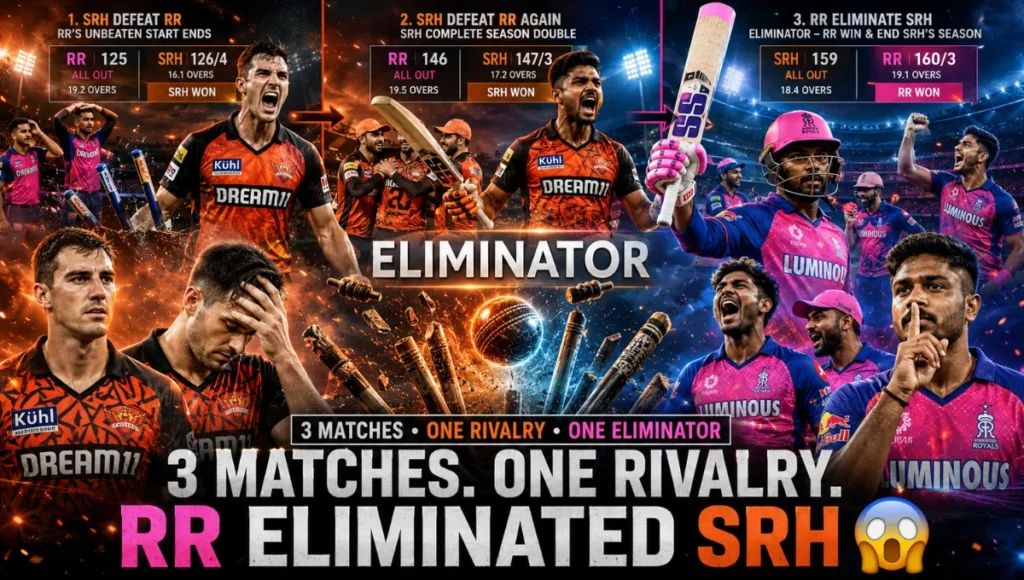

Sunrisers Hyderabad beat Rajasthan Royals twice. They ended RR’s unbeaten start with a historic batting collapse, then beat them again three weeks later to complete the season double.
Then, in a single Eliminator, none of that mattered.
Rajasthan Royals eliminated Sunrisers Hyderabad from IPL 2026 in one match, ending a six-game winning streak in the head-to-head and, with it, SRH’s entire season. This is the complete Rajasthan Royals vs Sunrisers Hyderabad standings story three matches, and how each one moved both teams closer to, or further from, the trophy.
The Standings Story at a Glance
| Match | Date | Venue | Result | Standings consequence |
|---|---|---|---|---|
| 21st Match | 13 April 2026 | Rajiv Gandhi International Stadium, Hyderabad | SRH won by 57 runs | Ended RR’s unbeaten start; damaged RR’s net run rate |
| 36th Match | 25 April 2026 | Sawai Mansingh Stadium, Jaipur | SRH won by 5 wickets | SRH completed the season double over RR; extended head-to-head streak to 6 |
| Eliminator | 27 May 2026 | Maharaja Yadavindra Singh Stadium, Mullanpur | RR won by 47 runs | SRH eliminated from IPL 2026; RR advanced to Qualifier 2 |
The one-sentence season story: Sunrisers Hyderabad won the standings battle twice during the group stage, but Rajasthan Royals won the only meeting that actually decided a season.
Match 1: The 21st Match: RR’s Historic Collapse
The 9/5 collapse and its net-run-rate cost
Sunrisers Hyderabad posted 216/6, then dismantled Rajasthan Royals for just 159.
RR’s innings effectively ended before it began: they slipped to 9 for 5, a genuinely historic collapse the second-lowest IPL score at the fall of the fifth wicket in the competition’s history, behind only Kolkata’s 6/5 against Deccan Chargers in 2011.
What most people miss: a 57-run defeat looks like a comfortable SRH win on the scoreline alone. The standings damage was actually worse than the margin suggests, because RR’s net run rate took a significant hit from conceding 216 and then collapsing to 159 a differential that would matter in close finishes later in the season.
Two debutants who changed RR’s early-season trajectory
SRH handed debuts to two uncapped pace bowlers, Praful Hinge and Sakib Hussain, and both destroyed RR’s top order. Hinge took a three-wicket haul inside the very first over of the innings the first time any bowler had achieved that feat in IPL history finishing with 4/34. Hussain added 4/24 in his own debut spell.
Counterintuitive point: teams rarely expect their standings to be shaped by two players making their first appearance in the competition.
SRH captain Ishan Kishan explained the decision simply: “you also have to look how hungry your young bowlers are” a reminder that bold team-selection risks can produce the single most standings-relevant performance of an entire month.
Match 2: The 36th Match: SRH Complete the Double
Sooryavanshi’s century in a losing cause
Twelve days later, in Jaipur, Rajasthan Royals posted 228/6, built on Vaibhav Sooryavanshi’s second IPL century 103 off 37 balls and a supporting fifty from Dhruv Jurel. Sunrisers Hyderabad chased it down at 229/5 in 18.3 overs, with Ishan Kishan making 74 and Abhishek Sharma adding a rapid 57.
This is where things go wrong for even a brilliant individual performance: Sooryavanshi’s century was RR’s best batting effort of the match, and it still wasn’t enough. A team can win the “highlight reel” of a game and still lose the standings battle if the other side’s collective effort matches or exceeds it.
What the double meant for both teams’ standings
This defeat completed a season double for Sunrisers Hyderabad and extended their head-to-head dominance over Rajasthan Royals to six consecutive wins dating back to 2023 joint with Chennai Super Kings’ 2010-2013 streak for the most consecutive wins by any team against RR in IPL history.
Bold opinion: at this point in the season, most analysis would have reasonably concluded that SRH simply had RR’s measure a psychological and tactical edge that would likely continue into any future meeting. That assumption turned out to be completely wrong, and the reason why is the most valuable lesson in this entire standings story.
Read Also:- England Cricket Team Vs India National Cricket Team Stats
Match 3: The Eliminator: Everything Reverses
Sooryavanshi’s second century, this time in a winning cause
In the Eliminator, with elimination on the line for both sides,
Sooryavanshi produced arguably his most destructive innings of the season: 97 off just 29 balls, taking RR to 125 runs inside eight overs. He came agonisingly close to breaking Chris Gayle’s record for the fastest century in IPL history before falling just short of triple figures. RR finished with 243/8, with Dhruv Jurel again offering support with a fifty.
Original observation: Sooryavanshi’s two innings against the same opponent 103 in a defeat, 97 in a season-defining win form one of the most instructive individual arcs in the sport. The difference between the two results wasn’t his personal form, which was excellent both times; it was whether his team’s collective bowling and fielding could back up what he built.
The six-match streak ends, and so does SRH’s season
Jofra Archer struck early and dismantled SRH’s top order inside the powerplay. Heinrich Klaasen, so often SRH’s rescue option, fell without making an impact. SRH’s lower order staged a brief counterattack but kept losing wickets, eventually falling 47 runs short at 196.
The match also produced 26 sixes the most ever hit in a single IPL knockout or playoff match, beating the previous record of 25 sixes in the 2025 Eliminator between Mumbai Indians and Gujarat Titans. SRH’s six-match winning streak over RR, dating back to 2023, ended in the only match of the three that actually determined a season’s outcome.
Bold opinion: there is a specific, repeatable lesson in this reversal for any team building a head-to-head advantage during a group stage.
RR captain Riyan Parag’s own words afterward were telling: “when everything’s on the line, I feel everyone works really hard towards it.” A dominant regular-season record means comparatively little if a team cannot reproduce the same intensity when the stakes turn binary win or go home.
Player Performance Breakdown Across the Standings Battle
Vaibhav Sooryavanshi: the constant across all three standings-shifting matches
Across the three meetings, Sooryavanshi’s form never wavered he simply needed his team around him to convert that form into results. His 97 in the Eliminator also pushed him past Chris Gayle’s 2012 record for most sixes in a single IPL season, finishing with 65 sixes at a rate of one every 4.3 balls faced, comfortably the most efficient six-hitting season in IPL history.
Practical lesson for reading individual form within a team result: judging a player purely by win-loss outcomes can obscure genuinely exceptional, consistent performance. Sooryavanshi’s numbers were elite in both the loss and the win the standings swung on everything happening around him, not on any change in his own game.
Praful Hinge and Sakib Hussain: the debutants who shaped the opening standings gap
Their combined 8/58 on debut in the 21st Match was directly responsible for RR’s early-season standings damage. SRH became only the second team in IPL history to have their seamers take 10 wickets in an innings, following their own 2016 performance against Mumbai Indians in Visakhapatnam.
Common mistake in analysis: treating a debutant’s big performance as a one-off surprise rather than a genuine standings-shaping event. Both bowlers directly cost RR a match that damaged their net run rate for weeks, a tangible, lasting consequence rather than a passing highlight.
Jofra Archer: the bowler who decided the Eliminator’s standings stakes
Archer’s early breakthrough in the Eliminator set the tone for SRH’s chase to unravel.
His own explanation was direct: “usually the team that gets the most wickets in the powerplay, usually wins the game.” His powerplay strike in the match that actually mattered undid two prior defeats in the head-to-head completely.
Ishan Kishan and Abhishek Sharma: SRH’s standings-building duo in the group stage
Kishan’s 74 and Abhishek’s 57 in the 36th Match were central to SRH completing the double over RR. Their partnership-building approach in that specific match reflected SRH’s broader season strength a batting unit capable of chasing 200-plus totals “in each and every game,” in Kishan’s own words.
Analysis: Reading a Head-to-Head’s Standings Impact
Why the group-stage double didn’t guarantee anything
What people think: a team that wins both group-stage meetings against an opponent, especially while extending a multi-season winning streak, has established a clear psychological and tactical edge heading into any future encounter.
Reality: the Eliminator proved this assumption false in the most consequential way possible. SRH’s captain Pat Cummins was honest about the specific factors that changed: “the margins are so small… if you miss your yorker by a little bit, he doesn’t tend to miss them” describing Sooryavanshi’s growth as a batter, not SRH’s own decline, as the key variable.
The Eliminator’s brutal, binary stakes
Unlike the two group-stage meetings, where a loss simply meant lost points and a net-run-rate hit, the Eliminator carried binary stakes: win and advance to Qualifier 2, lose and the season ends immediately. This context fundamentally changes how a “standings” analysis should weigh the three results.
Practical takeaway for reading playoff cricket: a group-stage head-to-head record, however dominant, provides essentially zero predictive value once a tournament reaches a single-elimination structure. Rajasthan Royals’ Eliminator win should be weighted as equal in importance to, or arguably more significant than, both group-stage losses combined not because of the runs or wickets involved, but because of what a single defeat would have meant for either team’s season.
Read Also:- India Women’s National Cricket Team Vs West Indies Women Match Scorecard
Records, Season Legacy and Format Guardrail
Records set across the three meetings
| Record | Detail |
|---|---|
| Lowest IPL score at fall of 5th wicket (2nd all-time) | RR’s 9/5 in the 21st Match, behind only 6/5 for KTK vs Deccan Chargers in 2011 |
| First bowler to take a hat-trick in the opening over | Praful Hinge, 21st Match |
| Most consecutive wins vs RR in IPL (joint record) | SRH’s 6 wins (2023-2026), tied with CSK’s 2010-2013 streak — ended in the Eliminator |
| Most sixes in a single IPL season | Vaibhav Sooryavanshi, 65, surpassing Chris Gayle’s 59 in 2012 |
| Most sixes in an IPL knockout/playoff match | 26 sixes in the Eliminator, beating the previous record of 25 |
Format and fixture guardrail
| Fixture | Correct context |
|---|---|
| RR vs SRH, 21st Match, IPL 2026 (this article) | First group-stage meeting — SRH win |
| RR vs SRH, 36th Match, IPL 2026 (this article) | Second group-stage meeting — SRH win, completing the double |
| SRH vs RR, Eliminator, IPL 2026 (this article) | The playoff decider — RR win, SRH eliminated |
| SRH vs RR, 2021 (Punjab Kings archive) | A completely different, unrelated season |
Do not present the 2021 fixture’s figures as part of this 2026 standings analysis. It belongs to an entirely separate point in the two franchises’ history.
Frequently Asked Questions
Ans. They played three times: the 21st Match (SRH won by 57 runs), the 36th Match (SRH won by 5 wickets), and the Eliminator (RR won by 47 runs).
Ans. Yes, in the group stage. SRH won both the 21st Match and the 36th Match, completing the season double. However, RR won the decisive Eliminator, which mattered far more for both teams’ final standings.
Ans. Rajasthan Royals eliminated Sunrisers Hyderabad, winning the Eliminator by 47 runs at Mullanpur on 27 May 2026.
Ans. Sooryavanshi scored 103 in the 36th Match (in a losing cause) and 97 in the Eliminator (in a winning cause), and finished the season with a record 65 sixes, the most in a single IPL season.
Ans. Before the Eliminator, SRH had won six consecutive matches against RR dating back to 2023, a joint-record streak. RR’s Eliminator win ended that streak.