
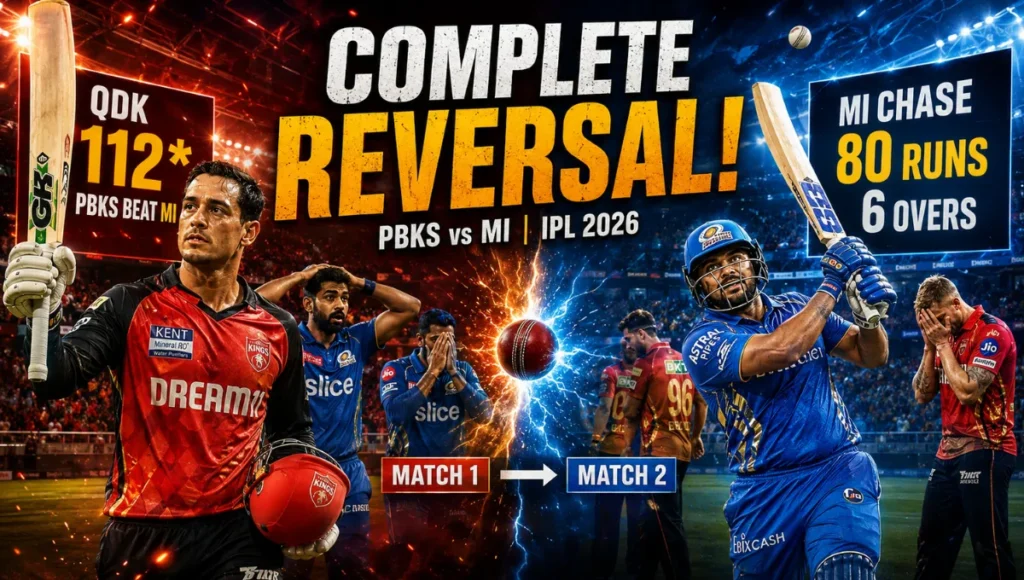

Quinton de Kock scored a century. Mumbai Indians still lost.
A month later, Punjab Kings collapsed from a promising position and Mumbai Indians chased down 80 runs in the final six overs like it was routine. This is the complete Punjab Kings vs Mumbai Indians timeline for IPL 2026 two matches, one complete reversal, and the story of exactly what changed in between.
The Timeline at a Glance
| Chapter | Date | Match | Venue | Result |
|---|---|---|---|---|
| 1 | 16 April 2026 | 24th Match | Wankhede Stadium, Mumbai | Punjab Kings won by 7 wickets |
| 2 | 14 May 2026 | 58th Match | Maharaja Yadavindra Singh Stadium, Mullanpur | Mumbai Indians won by 6 wickets |
The one-sentence season story: Punjab Kings won the first meeting comfortably despite Quinton de Kock’s century, but Mumbai Indians reversed the entire rivalry a month later, with Tilak Varma calmly finishing off a tricky chase that PBKS’s own coaching staff later admitted they lost control of.
Chapter 1: 16 April De Kock’s Century Wasn’t Enough
Mumbai Indians posted 195/6, built almost entirely around Quinton de Kock’s 112 off 60 balls. It was a genuinely exceptional individual innings more than half of MI’s entire total came from one bat.
What most people miss: a century that accounts for the majority of a team’s total is often a warning sign, not just a highlight. It meant MI’s remaining batters combined for fewer than 85 runs between them, leaving very little margin if the total needed defending against a team batting with real intent.
That’s exactly what happened. Punjab Kings chased down 195 with real comfort, reaching 198/3 in just 16.3 overs. Prabhsimran Singh led the chase with 80 off 39 balls, while Arshdeep Singh’s earlier bowling figures of 3/22 had already limited MI’s total from potentially going higher.
This is where things go wrong for a team relying on one special innings: De Kock’s century was genuinely brilliant, but a T20 total needs contributions from at least two or three batters to be defendable. PBKS’s chase never looked seriously troubled, because MI’s bowling attack, without the same margin for error their batting had failed to provide, had too little to work with.
The Month Between: What Changed for PBKS
Between the two matches, Punjab Kings’ form took a genuine downturn. By the time of the second meeting, former players and analysts were publicly diagnosing specific problems with the team’s approach.
Former Australian wicketkeeper Brad Haddin said plainly that PBKS “haven’t been able to handle the pressure” and had “lost their way with the bat.” Analyst Abhinav Mukund went further, pointing to a specific tactical decision holding back Yuzvendra Chahal’s final over as something that “cost them the game” in a subsequent contest.
Counterintuitive point: a team that wins its first meeting against an opponent comfortably can still be heading toward a much tougher second meeting, if the underlying issues commentators are already flagging don’t get addressed. PBKS’s coaching staff being this openly self-critical in the media, before the rematch even happened, was itself a signal of a team under genuine internal pressure.
Chapter 2: 14 May Tilak’s Calm Amid Chaos
A month after their comfortable win, Punjab Kings’ innings told a completely different story. They reached 111/2 in encouraging fashion, with Priyansh Arya and Prabhsimran Singh again contributing (Prabhsimran’s second half-century of the timeline, 50 off 29 balls). Then the innings fell apart.
PBKS lost their next six wickets for just 55 runs, going from 111/2 to 166/8, before finishing at 200/8. Shardul Thakur took three wickets in this collapse phase for Mumbai Indians, including a spectacular diving catch to remove Suryansh Shedge.
Bold opinion: PBKS’s collapse here is the direct, visible consequence of the exact issue Haddin and Mukund had flagged. A team that “hasn’t been able to handle the pressure” doesn’t just lose matches it loses control of matches it’s actually winning, at exactly the moment a platform needs converting into a match-winning total.
Mumbai Indians’ chase of 205 began shakily, losing Rohit Sharma, Naman Dhir, and having Ryan Rickelton fall for 48 by the ninth over, leaving them at 88/3. From there, needing roughly 80 off the final six overs, Tilak Varma took control.
Varma finished unbeaten on 75 off 25 balls, including a fifty that came off just 25 balls itself, guiding MI home with 6 wickets and 1 ball to spare.
ESPN’s own coverage captured the moment precisely: “On a tricky pitch, MI needed 80 off the final six overs but Tilak lined up the slower balls and finished it off in style.”
Original observation: the specific detail that Tilak targeted “slower balls” rather than simply swinging at everything shows a finisher reading the bowling plan being used against him, rather than relying purely on natural power. That’s a repeatable, teachable skill recognizing what a bowling attack is trying to do and attacking the specific delivery type they’re relying on, rather than treating every ball as an identical hitting opportunity.
Read Also:- Royal Challengers Bengaluru Vs Gujarat Titans Timeline
Player Performance Breakdown Across the Timeline
| Player | Chapter 1 (24th Match) | Chapter 2 (58th Match) |
|---|---|---|
| Quinton de Kock | 112 (60) — top scorer in a losing cause | Did not feature in the retrieved scorecard |
| Prabhsimran Singh | 80 (39) — powered PBKS’s comfortable chase | 50 (29) — set up a strong platform that later collapsed |
| Arshdeep Singh | 3/22 — key bowling contribution in the win | 0/29 — expensive, wicketless in the loss |
| Tilak Varma | Not a headline contributor | 75* (25) — match-winning finishing innings |
| Ryan Rickelton | Not a headline contributor | 48 — part of MI’s shaky start before the recovery |
| Shardul Thakur | Not a headline contributor | 3 wickets, including a spectacular catch — drove PBKS’s collapse |
Analysis: Reading a Two-Match Rivalry
Why a 7-wicket win didn’t settle anything
What people think: a comfortable 7-wicket win in the first meeting of a season suggests a clear, lasting advantage over that specific opponent.
Reality: the timeline shows the opposite. PBKS’s first win papered over a specific batting fragility over-reliance on De Kock’s century while their own vulnerabilities (loss of composure under pressure, questionable death-over bowling management) were still developing beneath the surface. By the second meeting, those same PBKS vulnerabilities directly caused their collapse from 111/2 to 200/8.
The tactical thread connecting both matches
Across both matches, the team that built a platform through one or two batters, but couldn’t convert it into sustained partnerships, ultimately lost. MI lost the first match specifically because their innings depended too heavily on De Kock. PBKS lost the second specifically because their innings collapsed after a similarly promising platform.
Practical takeaway for reading a season rivalry: the specific pattern strong platform, insufficient conversion repeated on both sides of this timeline, just in different matches. That’s a more useful analytical thread than simply noting “each team won once.”
Records, Season Context and Format Guardrail
Season context
Both matches took place at neutral or partially-neutral venues for Punjab Kings, with the second match played at Mullanpur in New Chandigarh rather than a traditional home venue, reflecting the team’s evolving home-ground arrangements during IPL 2026.
Format and fixture guardrail
| Fixture | Correct context |
|---|---|
| MI vs PBKS, 24th Match, IPL 2026 (this article) | First 2026 meeting — PBKS win |
| PBKS vs MI, 58th Match, IPL 2026 (this article) | Second 2026 meeting — MI win |
| PBKS vs MI, 2025 (Punjab Kings archive) | A completely different, unrelated season |
Do not present the 2025 fixture’s figures as part of this 2026 timeline. It belongs to an entirely separate season and squad composition for both franchises.
Frequently Asked Questions
Ans. They played twice: the 24th Match on 16 April 2026 (Punjab Kings won by 7 wickets) and the 58th Match on 14 May 2026 (Mumbai Indians won by 6 wickets).
Ans. Punjab Kings won the first meeting by 7 wickets, chasing down Mumbai Indians’ 195/6 at 198/3, despite Quinton de Kock’s century of 112 for MI.
Ans. Punjab Kings’ form declined between the two meetings. Former players and analysts publicly flagged the team’s struggles handling pressure and specific tactical issues, which directly preceded their batting collapse in the second match.
Ans. Tilak Varma was the standout player, finishing unbeaten on 75 off 25 balls to guide Mumbai Indians to a successful chase of 205, needing 80 off the final six overs.
Ans. No. De Kock scored 112 off 60 balls in the first meeting, but Mumbai Indians still lost by 7 wickets, as Punjab Kings chased down the target comfortably.